


OMIM ID:
Marshall Syndrome
Alternate Names
Defective Genes
Clinical Characteristics
Ocular Features
Myopia is a common feature. The globes appear prominent with evident hypertelorism, perhaps in part due to shallow orbits. The vitreous is abnormally fluid. The beaded vitreous pattern seen in Stickler syndrome type II (604841), with which Marshall syndrome is sometimes confused, is not seen in Marshall syndrome, nor is the same frequency of retinal detachments. Congenital or juvenile cataracts were present in Marshall’s original family.
Systemic Features
The midface is flat with some features of the Pierre-Robin phenotype. The nasal root is flat and the nares anteverted. Patients tend to be short in stature and joints are often stiff. Small iliac wings and a thickened calvarium can be seen radiologically together with other bone deformities. Abnormal frontal sinuses and intracranial calcifications have also been reported. Sensorineural hearing loss may be noted during the first year of life with age-related progression. Osteoarthritis of the knees and lumbosacral spine begins in the 4th and 5th decades. Features of anhidrotic ectodermal dysplasia such as hypohidrosis and hypotrichosis are present in some patients. Individuals may have linear areas of hyperpigmentation on the trunk and limbs.
Genetics
Inheritance
The syndromal status of Marshall syndrome as a unique entity remains uncertain inasmuch as there are many overlapping clinical features with Stickler syndrome type II (604841) and both result from mutations in the COL11A1 gene (1p21). Autosomal dominant inheritance is common to both although autosomal recessive inheritance has been proposed for a few families with presumed Marshall syndrome. Stickler syndrome type II (604841) and Marshall syndrome may be allelic or even the same disorder.
Pedigree
Autosomal dominant
Autosomal dominant disorders require only one mutation for the disease to be expressed. Since an affected parent has two chromosomes, only one of which has the mutant gene, parents can expect that half (50%) of their children will receive that one and inherit the disease. It is common for individuals that inherit the mutation, however, to not have evidence of the disease (nonpenetrance).
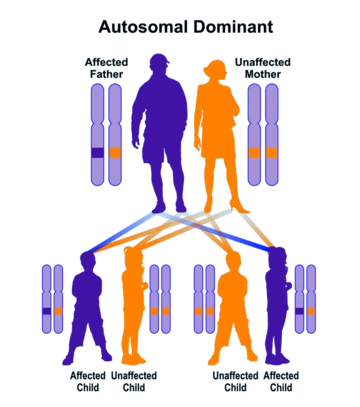
Autosomal dominant inheritance leads to a vertical pattern of transmission
Autosomal recessive
In order for autosomal recessive disorders to be expressed, offspring generally must inherit two mutations, one from each carrier parent. Carriers with only one mutation, such as the parents, do not have clinical disease. Note that carrier parents can expect that 1 in 4 children (25%) will inherit both mutations and have the disorder, 2 in 4 children (50%) will be carriers like their parents, while 1 in 4 children (25%) inherit neither mutation.

In order for autosomal recessive disorders to be expressed, offspring generally must inherit two mutations, one from each carrier parent. Carriers with only one mutation, such as the parents, do not have clinical disease. Note that carrier parents can expect that 1 in 4 children (25%) will inherit both mutations and have the disorder, 2 in 4 children (50%) will be carriers like their parents, while 1 in 4 children (25%) inherit neither mutation.